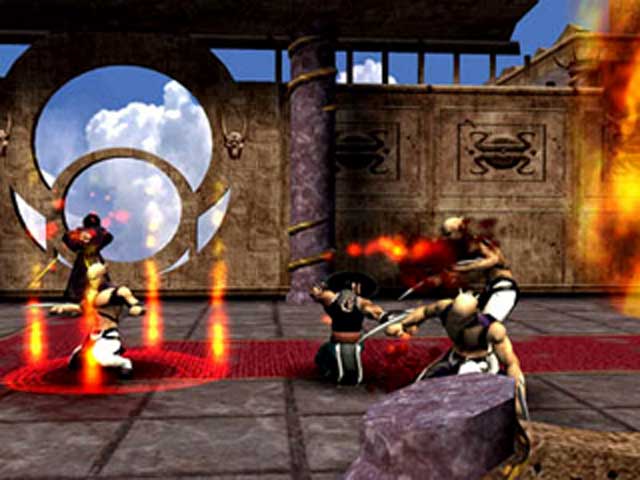
As far as role-playing games go, none have ever been as ambitious as the infamous Fable, a game that was originally released for the Xbox and promised to tell the story of a hero from childhood into adulthood and beyond. Fable: The Lost Chapters is a drastically extended version of the original game and seamlessly adapted for the PC. While any PC gamer may consider a port of a console title to be dumbed-down, upon playing Fable they may be pleasantly surprised. While Fable is a straightforward hack n’ slash RPG under the hood, it sports some ambitious elements on the outside and while these do little to affect the overall story arc and can seem pretty shallow, they help to make Fable a unique RPG experience.
Fable: The Lost Chapters begins in the small town of Oakvale where you play a small nameless boy who has to get money for a present for his sister’s birthday. When your father sends you out to find your sister, you’re free to wander the town where you can learn the basics of the game like how to talk to people and how to manipulate objects depending on the different auras they give off. If you choose to explore, you’ll be introduced to the driving theme of the game being the moral system where you’ll come across townsfolk who will ask you for help doing such menial tasks as finding teddy bears, watch a farmer’s crates in a barn while he tends to nature’s call, or chasing away a bully. In each of these situations you can choose to either choose to be good by beating up the bully or resist destroying the farmer’s crates for the stuff inside or you can choose the path of evil by siding with the bully and beating up the little kid with him or destroying the farmer’s crates and taking the goods for yourself. After some time passes, a group of bandits raid the town, kill your father, and take your sister and mother away. You manage to survive thanks to a man named Maze who whisks you out of town and takes you to the hero’s guild where you’ll spend the rest of your childhood training for a life of adventure.
Once you start training at the heroes’ guild you’ll learn the elements of combat such as melee, archery, and magic which the game refers to as will. After a short mission and a skill test, you graduate from the guild and embark into adulthood where the rest of Fable’s gameplay takes place. You can clear your childhood in anywhere from 45 minutes to an hour depending on how much you explore. Upon reaching adulthood, the game becomes a little less linear and a little more interesting.
The guild acts as a hub of your operations which you can frequent to choose quests and cash in your experience points towards skills. Skills make up three main categories consisting of strength, skill, and will. Depending on how choose to take on certain quests, you’ll gain experience towards these three categories separately. If you hack and slash your way through a quest, you’ll gain experience for the strength skill which you can increase your ability to resist damage, maximum HP level, or overall damage from melee attacks. If you choose to use magic then you’ll get experience towards will, which you can earn different types of magic and make your current spells more powerful. You’ll earn experience points towards skill from using ranged attacks like bows and crossbows and can cash those in towards increasing your ranged attack damage, attack speed, and stealth stats. Of course, the game doesn’t try to make you figure this all out for yourself thanks in part to helpful text and voice walkthroughs. Experience rewarded for completing quests is added to a general experience pool which you can spend on anything you want, though no matter how hard you try, you’ll most likely never end up with a pure fighter, archer, or magic user without some tricky exploits.
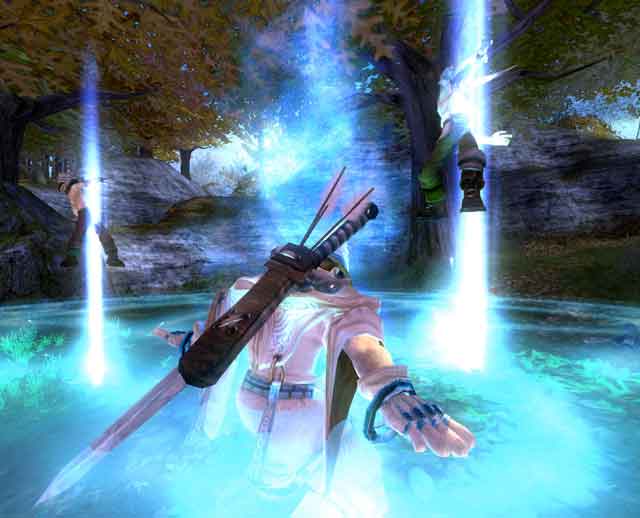 In addition to the quests that advance the story (which are designated by yellow guild icons), the linearity of the game is broken up by small side quests that can help you gain some much needed experience and the chance to find some handy items. Quests are the typical assortment of dungeon crawling hack and slash missions, escort missions, fetch quests, and even some stealth missions thrown in for good measure. You can even accept a quest and boast which will give you additional objectives like completing the quest within a specific time limit or under certain conditions which might help with the replay value for return players. While some missions offer some pretty neat and humorous experiences, the majority are typical for an RPG of this type.
The controls are translated well to the PC and use a standard WASD and mouse configuration to walk and look around. Combat is simple to pick up where you can lock on to a target by hitting the space bar and attack by clicking the left mouse button. Multiple clicks of the left mouse button will let you perform combos that will build up your combat multiplier for increased damage and experience points as long as you don’t get hit. A successive number of hits will cause your weapon to glow which will allow you to deal out a pretty powerful attack that can’t be blocked. Holding down the left shift key will bring up your spell menu where you can scroll through your available spells and cast them with the right or left mouse button. You can also drag the spells around on the grid so that your favorite spells will always be readily available. You can easily switch between ranged and melee weapons by hitting the E and Q keys which is handy when you’re taking shots at enemies that are running towards you with the bow and need to quickly switch to your melee weapon. Of course, the enemies will perform the same tactics to you as well in a brilliant stroke of artificial intelligence.
The game’s interface is pretty intuitive, though you’ll have to click through three menus just to find a specific item most of the time. Equipping armor can also be pretty painful since it’s divided into categories for each part of the body it covers. The game tries to take some of the pain away by offering different suits based off of types of armor that you have. If you own a couple of plate armor items, the game will give you the option of equipping the plate suit, though oftentimes it’ll leave you without pants or any other missing items in the process, but it at least helps to do some of the work for you.
Perhaps one of the best elements of the game’s interface is the dynamic quick menu that is displayed in the lower left portion of the screen where the game will assign three context sensitive actions to your function keys depending on the situation you find yourself in. If you find yourself badly wounded, a healing potion will be assigned to the F2 key automatically. If you’re wooing a lady, flirt gestures and gifts will be assigned to the F1, F2, and F3 keys accordingly. This beats the hell out of having to continually visit your inventory screen and constantly assign healing potions and other items to your quick keys, though you’ll find yourself having to do so here and there, but only on rare occasions.
There is a vast selection of weapons, armor, and clothes available for your hero. You’ll find a wide variety of swords, hammers, maces, crossbows, and axes available for you to purchase. The same goes for armor where you’ll find a lot of different chest plates, leggings, boots, gloves, and headpieces to help you survive a little longer in battle. You can unequip your armor at any time and wear different styles of clothes, or just run around in your underwear if you feel like it. You can also change the physical appearance of your character such as hairstyle or facial hair to increase and decrease your attractiveness and scariness. It’s the things you can do with your character is where the real fun of the game begins.
Your appearance and past deeds directly affect how people look at you. Depending on if you’ve lived a good or bad life, people will gather 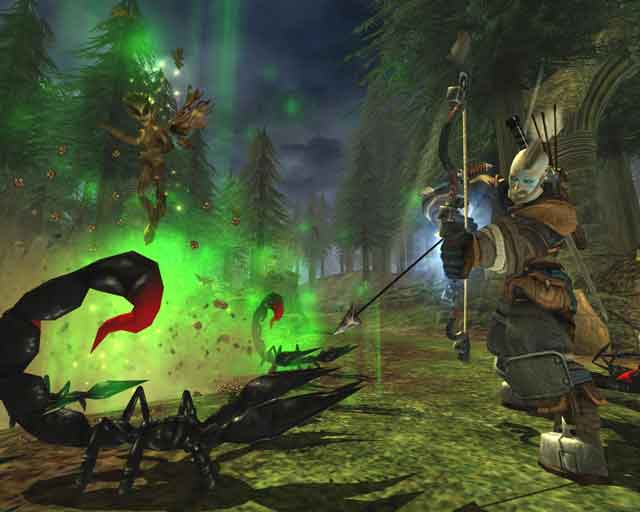 around and applaud while the women swoon, or flee in terror from you. The same goes for your character’s appearance. Doing good will make you glow and appear angelic while going to the side of evil will make you turn pale and foreboding with red eyes. You’ll periodically come across people who need help or just enticing situations that really make you question your morals. No matter what your alignment is, you can commit crimes in towns by stealing from merchants or killing people which will rack up evil points. You can also get good points for obeying the law and being helpful. You’ll get some interesting and funny reactions out of the townspeople like when you’re first starting out they’ll call you a chicken chaser and you’ll hear people whispering it among the background noise. They’ll even become snide and sarcastically say that your small deeds are so heroic. If you’re running around naked or sporting the crazy merchant’s mustache, people will start laughing and calling you names. You can react right back to them in different ways depending on what your alignment. Evil characters can sneer and belt out evil, maniacal laughter while good characters can pose and give hearty laughs. Part of the fun of completing a quest is to walk back into town and see how people are reacting to you, especially when your respect level goes up and you start to become recognized. Your character will age as the game progresses, though age doesn’t seem to hinder him one bit. Whether you’re twenty or fifty, your character will still play out the same way. The rigors of battle will also give your character permanent scars which is really cool, but people who get overly attached to their characters might not approve too much.
The NPCs exhibit some really nice AI with the gathering crowds around the popular heroes and boos and jeers directed towards not-so-popular heroes. When night falls, NPCs will light the street lamps as well as the lamps in whichever house you own which is a really nice touch. Though one would wonder why the mothers would allow kids to play in the street at all hours of the evening is beyond me.
Of course, there comes a time in any man’s life when he needs to find a lover and marry. You’ll first notice men and women noticing you when they start paying you compliments as you walk by. Men and women who are in the market for some wooing will have small hearts over their heads. Walking up to them, flirting, talking, and other positive gestures will cause the heart to grow bigger. Giving gifts will also gain you extra ground. When they can take no more of your pursuit, they’ll want a wedding ring and a house. Once that happens, they’re yours for the keeping until death do you part, which ultimately means you’ll end up killing them. The game will actually allow you to have multiple wives or husbands without any kind of consequence, provided they’re not in the same town. While this is really cool at first, you eventually come to realize that it’s pretty shallow since there’s no actual conversation that takes place between your often mute character and your prospect of love. Casual transactions consist of you doing a positive gesture over and over while the woman giggles and gives the same response over and over until it’s time to pop the question. Once married, they’ll exclaim how happy they are over and over until it’s time to have sex. Who says marriage is all about communication anyways?
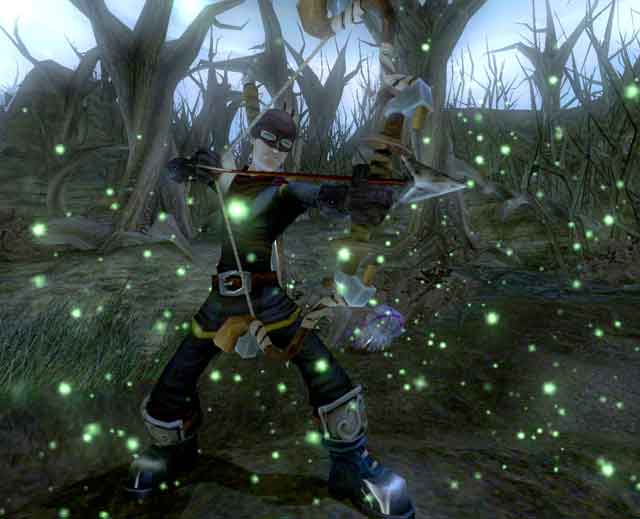 The world of Albion is segmented into different sections that range in size and separated by load screens. While the load times are generally fast, they’re pretty frequent and make the world lack any kind of cohesiveness or seem expansive by any means. It’s easy to navigate around thanks in part to your handy mini map and teleporters placed near every major location. The environments are what make the game a real visual treat. Every town looks like it’s bustling with activity and buildings, both inside and outside, spare no detail. Houses that you own will elaborately decorated depending on how much money you sink into them as well. Other less welcoming environments are also well detailed likes caves, swamps, and mountains. Though you’re usually limited to sticking to the beaten path, they often branch out allowing you to explore and find hidden items, keys, treasure chests, and even extra side quests.
After the main storyline is over, the expanded levels kick in with an all new greater threat to take care of. The lost chapters take place north of Albion and feature new environments and even tougher monsters. Though not as populated as Albion, you’ll meet a few new characters and even visit a bordello (which you can later take ownership of) during your adventures. The Lost Chapters provides a new continent to explore and is surprisingly larger than can be expected, add to that new items, weapons, and said monsters and it’s almost worth playing through again for those who have already finished the game on the Xbox.
Aside form the detailed environments, every character and NPC in the game is well detailed and seem to be lifelike until you actually come up and talk to them. The effects of your decisions on your character are nothing short of stunning as you see them either start to go pale and start gathering flies or start glowing with a white aura. Eating and drinking too much will also cause them to get fat which is pretty humorous. The foes that you’ll encounter along the way look great, but are repeated often. Some characters, like the werewolves you find in the swamps and other places, seem to lack any real detail. The animation for your hero and his foes are well done and pretty seamless during transitions. There are a few issues with clipping here and there as I actually witnessed one ofmy wives stand up and walk through a wall only to come back out through some nearby stairs. Spell effects are also very impressive, from the lowliest lightning bolt to the mightiest fireball are all pretty over the top and nice looking.
Major cutscenes and plotlines are displayed through paintings that look really great and really fit the intended time period, that is, if there were a real country called Albion that that actually had a renaissance period.
Shadows and lighting effects are all over the place and display well even on low end PCs. Despite getting a 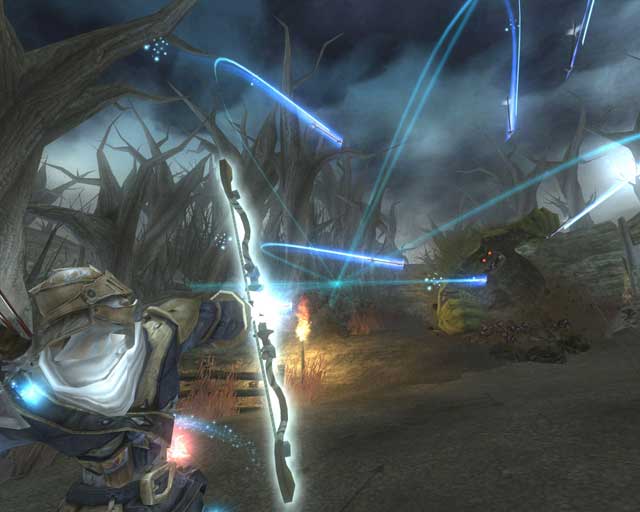 warning about my processor speed when I first launched the game, there was barely a stutter in the action even after upping the shadow and character details a couple of notches. There is also a great transition from day to night, just because I want to mention it.
The sound for the game is really well done and features an epic orchestrated soundtrack that should be winning awards. While your character barely speaks, there is a ton of spoken dialog here and the voice acting on all of the other characters is really well done and very British. The sound production is top notch on such small things as the busy noises of towns to the chatter between merchants and even the noise of dropping coins at a collection plate in one of the game’s two temples. The only thing that brings the sound down are the limited answers and reactions you’ll get from the townspeople, it’s just not varied enough.
While Fable didn’t live up to the ambitious promises made before its release, it’s still a very solid game with a lot of unique and fun elements going for it. While some may have complained that the original game was too short, the extra continent and extra exploration will pad some extra play time on. Whether or not this is worthy of a purchase for those who have finished the Xbox version is a tough call. On one side you have a lot of extra content, on the other, those players would have to endure about fifteen hours of a game they’ve already played through to experience it. This is ideal for those who have never played the game because it’s surely a game that needs to be experienced and should let PC gamers know that there are some good console to PC ports out there.
- Brad Hicks (Dr. Swank), SwankWorld Media